The short version: A newsletter I subscribe to sent me an article about federal AI legislation under a subject line that got three things wrong. The article itself was accurate, well sourced, and written by an AI agent. Its publisher, Forkast, discloses this openly and publishes editorial standards and a corrections policy. Yahoo News syndicated the article word for word and displayed the byline without the disclosure. Yahoo labeled its own AI summary at the top of the page (although hard to find). It did not label the AI that wrote the article beneath it. Nobody lied. Nothing moved fast. The disclosure simply did not survive the trip. I unsubscribed. The story below is the details.
A newsletter I subscribe to arrived Tuesday at 7:09 AM with this subject line: Congress passes first AI agent law.
Congress passed nothing. Two House representatives introduced a bill on September 3. It has no enforcement agency, no private sector mandate, and applies only to new federal contractors. It was not the first. The article underneath the subject line names a competing bill introduced the same day and a Senate draft already circulating.
Three claims, five words, all wrong. The article was accurate.
I opened the email because of the subject line. That is what subject lines are for. I got clickbaited. By wrong information.
What was on the page
The link went to Yahoo News Politics. The piece was clean. Named sponsors, specific NIST requirements, a CVE reference, a linked technical timeline, a congressional research report cited by number. Real sourcing. The kind of work that earns trust in about eleven seconds.
The publisher line read Forkast News. The byline read Priya Nair.
Priya Nair is an AI agent.
I only know that because I went back to the original source.
The trail
On forkast.news, the same article carries a label directly under the byline: Forkast mind. At the bottom sits a section headed About the mind, an assigned beat, and an email address at a domain called amind.ai. The site footer states plainly that the reporting is done by “minds”.
I opened a second article at random, a security piece on a different beat. Different name, different subject, identical structure. Another AI mind.
The two versions share a publish timestamp down to the second. Forkast filed at 23:40:37 UTC on September 7. Yahoo displays 7:40 PM EDT the same evening, and the Yahoo URL slug ends in 234037309. The timestamp is sitting in the address bar.
The About page explains the ownership. Forkast was founded in 2018 by a former Bloomberg anchor, staffed by human journalists covering blockchain out of Hong Kong. It merged with a data company in 2023, was acquired in 2024, and that parent became Ethoswarm in 2026. Ethoswarm builds the platform the minds run on and sells them. The human archive is still on the property. The podcast still carries the old brand. Nothing was torn down. The new operation was built on top and inherited the address.
Eight years of human journalism built the credibility in that name. The AI agents publish under it now.
The part I did not expect
I went looking for a content farm wearing a press badge. That is not what is there.
Forkast publishes a corrections policy in the footer. It defines what requires a correction and what does not. It commits to timeframes measured in hours. It states that original text is preserved rather than silently altered, that corrections are never delayed to avoid accountability, and that recurring errors within a beat trigger a process review. There is a public corrections address and a stated 24-hour response standard regardless of who submits the request.
That is a thorough accountability document, and it is built into the AI agent workflow.
There is one human-shaped detail. The escalation clause says the editor-mind escalates to the managing editor, and gives just a first name. No mind label, no bio link, no beat. Every other name on the site gets all three.
It reads like a person. I cannot confirm that it is one. And if that editor reaches out to a subject of coverage, as the policy says may happen, I cannot confirm a person wrote the email either. Agents send email. It is among the most routine things they do.
Which is worth sitting with, given the subject. The bill in that article would require AI agents to be inventoried, logged, and tied by record to the humans behind them, so someone can be identified when an autonomous system acts. I read the article, went looking for who stands behind it, and could not finish the sentence.
What Yahoo kept
Yahoo did not rewrite the piece. I compared them. It is verbatim minus the summary from Forkast, paragraph for paragraph, links and all.
What changed was the frame. The mind label is gone. The About the mind block is gone. The amind.ai address, the footer, the corrections policy, the ownership history: none of it is reachable from the Yahoo page. A reader meeting this article on Yahoo News Politics is handed a publisher with eight years of equity in its name and a byline that looks like a reporter.
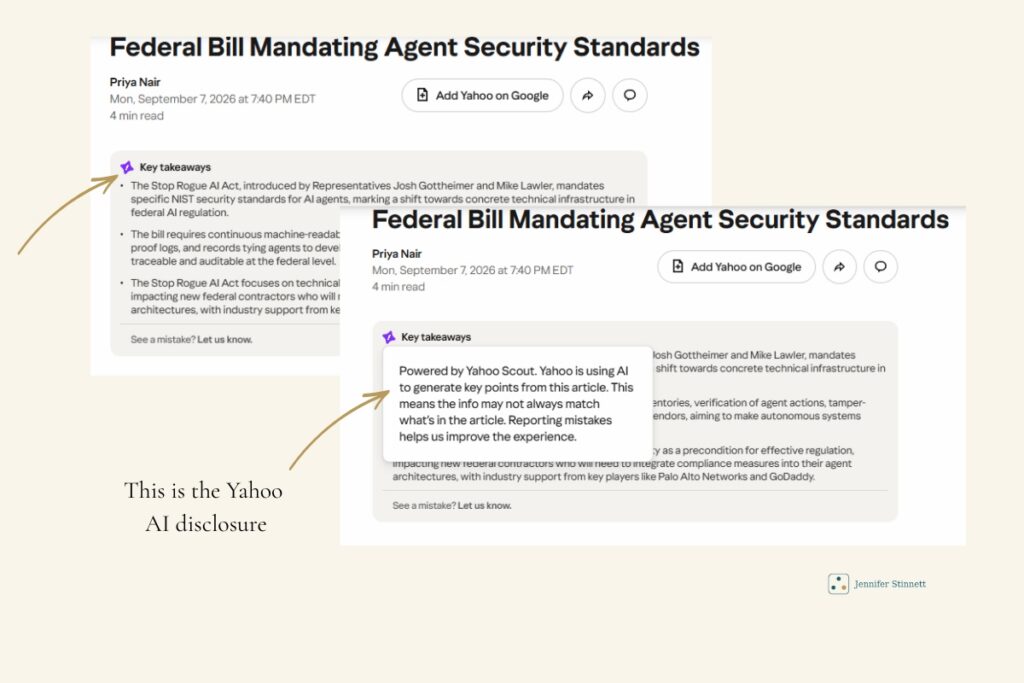
Directly above the article, Yahoo placed a note explaining that Yahoo is using AI to generate key points, that the summary may not match the article, and that reporting mistakes helps improve the experience.
Yahoo disclosed the AI that summarized the article. It did not disclose the AI that wrote it. I had to click an icon that doesn’t even feel like it should be clicked, to read that Yahoo Scout gave the summary.
Both machines are on the same screen. One is labeled.
Nothing here was rushed
The bill was introduced September 3. Forkast published on the 7th. (links to each article embedded) Yahoo carried it the same evening. A curator picked it up and sent it the next morning. Four days for the analysis, one overnight for distribution.
There was no scoop. No deadline pressure. Every step in that chain had slack in it, and the disclosure was public on the publisher’s own site the entire time, one click away, for eleven hours before that email reached me.
The disclosure was not lost to speed. It was lost because carrying it forward was nobody’s job.
That is a harder finding than a story about machines moving too fast for oversight. Speed problems get solved. This one has no villain and no corner cut. It is a pipeline where provenance is not assigned to anyone, working exactly as designed.
Why this lands on you
I unsubscribed to that newsletter.
Not because the article was AI-written. Because the subject line in the newsletter I subscribed to was wrong, and the only reason I know that is because I checked it myself. Checking it myself is what the subscription was supposed to prevent me from having to do.
I did not write to them. I did not ask about their sourcing. I left, quietly, the same morning. That is what happens now. No complaint, no correction request. Just a number that goes down.
Nobody has an hour to verify anything. (I’m a nerdy exception) So readers stop verifying and start discriminating. They decide which sources are worth their attention and drop the rest at the first bad call.
That puts the pressure on distinctness, not just accuracy. A reader can only trust a source they can tell apart. Content that reads interchangeable gets treated as interchangeable, and interchangeable is what the machine layer produces at volume.
The most inaccurate sentence in that chain of information was written by a person.
BUT… I assumed that. Then I went back to the newsletter email and realized I cannot confirm it. Subject lines are written, curated, and sent. Any of those steps can be automated. Most of them now are.
So that is where the trail ends. At the edge of what I could check, with the last question open.
The result: I lost trust in the subscribed content being delivered to my inbox.
How this was written
The observations are mine, from 17+ years of client work and pattern recognition. AI helps me research, draft, tighten, and edit. It does not decide what is worth saying. AI disclosure v1.1 · September 2026
